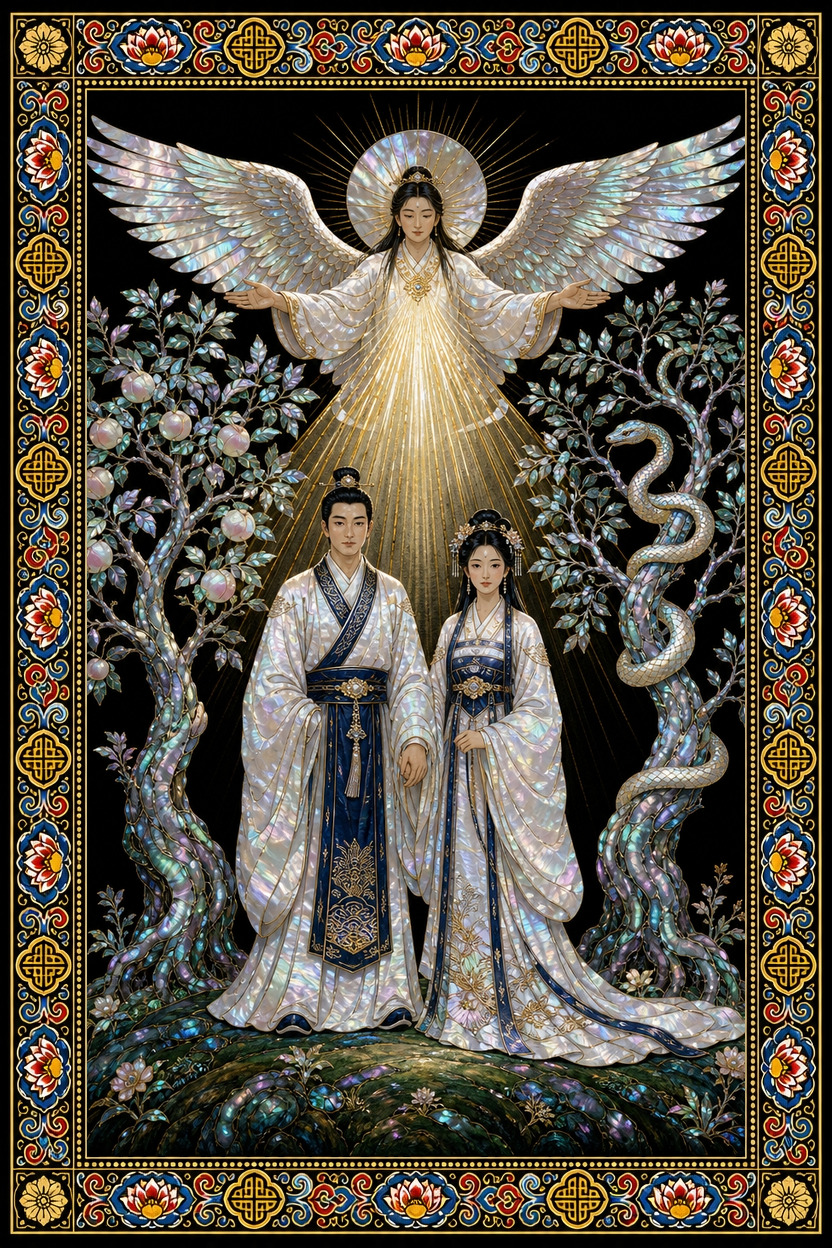
Major Arcana · The Lovers
The Lovers: Two Figures Between Two Trees Beneath a Winged Angel
Is the angel descending between these two a blessing, or a test? Following the layout of the image, we look at the weight of choice that the Lovers card speaks of.
『The Lovers』 — what this card actually draws
The eye goes first to the upper part of the image. A great angel with wings spread hovers above the two heads, and a pearly halo wraps around it. The angel sheds light toward the two people and stands between them.
Below, a man and a woman dressed in wedding robes stand side by side. The bride, her hair gathered up, stands on one side, and the man stands shoulder to shoulder with her. Rather than looking at each other, the two face straight ahead.
A tree stands at each side of the image. On the left is a peach tree, and on the right a tree with a serpent coiled around it. Two trees flanking the figures in symmetry are the backbone of this picture.
Symbols and meaning
Upright, this card reflects union and harmony. That the angel stands above the two is read as meaning their relationship is placed within a single order that goes beyond a matter between two individuals. The side-by-side posture of the two shows a balanced gaze toward each other.
At the same time, the picture holds a choice. The two trees at left and right symbolize two different paths, and the person standing between them comes face to face with which to take. So the love in this card includes decision, not feeling alone.
Reversed, that balance is shaken. It is read as a heart unable to find footing between the two trees and putting off the choice, or as a state drawn by temptation and tilting to one side. The misalignment points less to a relationship's ruin than to the point where balance was lost.
When this card appears
At work, it reflects a phase in which two or more parties become entangled, as in collaboration or a contract. If you are in a position where conditions must be matched with another, it is a signal to check whether things have tipped to one side.
In relationships, it asks about the depth of the connection. Ask yourself whether this is someone whose heart meets yours, or whether attraction and judgment are mixed together. In money, balance becomes the key in shared expenses or joint decisions.
In matters of choice, an attitude that does not postpone is what matters. As long as you stand between the two trees, neither one becomes yours. In an actual reading, a line like this may come up: "What you need now is not to pick the better side, but to take responsibility for the side you picked."
History and culture: the Egyptian origin myth and its refutation
The arrangement of the two trees and the angel in this card is often tied to the Egyptian origin theory that was popular in the eighteenth and nineteenth centuries. Court de Gébelin argued that tarot came from the Egyptian Book of Thoth, and the story followed that this image too carried the secret rites of ancient Egypt.
The source of this iconography confirmed in the literature, however, is different. The two trees, the figure between them, and the angel descending from above are a familiar composition in medieval European religious iconography. In particular, the interpretation that the two trees at left and right carry over the biblical image of the two trees is widely accepted.
De Gébelin's claim was later refuted through textual research as weakly grounded. It is close to the current consensus to hold that this card's imagery comes not from Egypt but from the visual language of medieval Europe. Leave the origin myth as an interesting footnote in cultural history.
Common misreadings
It is often assumed that when this card appears, romantic fortune is settled. But the center of the picture is the choice between the two trees, and the relationship grows on top of that decision. What you choose comes before whether love is present.
Another misreading is that this card always means only a joyful union. The misalignment of the reversed card is better read, faithful to the picture, as a signal to bring a shaken balance back into line rather than as a verdict to end the relationship.
Be careful, too, about seeing the angel as a judge of fate. The angel only sheds light from above the two; it does not decide on their behalf. The share of the choice still remains with the people standing beneath it.
Draw a card yourself
The picture you have just read can be placed against your own question. The same card answers differently when the question changes.
- A deck drawn in-house — 78 cards in the colours of nacre and dancheong
- Readings that read the picture, not a keyword list
- Keep asking — draw one more card for your next question
- A record you can return to and compare
- Let a friend draw for you with a single link
- Seventeen languages, one deck, one reading
More from this suit
