Major Arcana · The Emperor
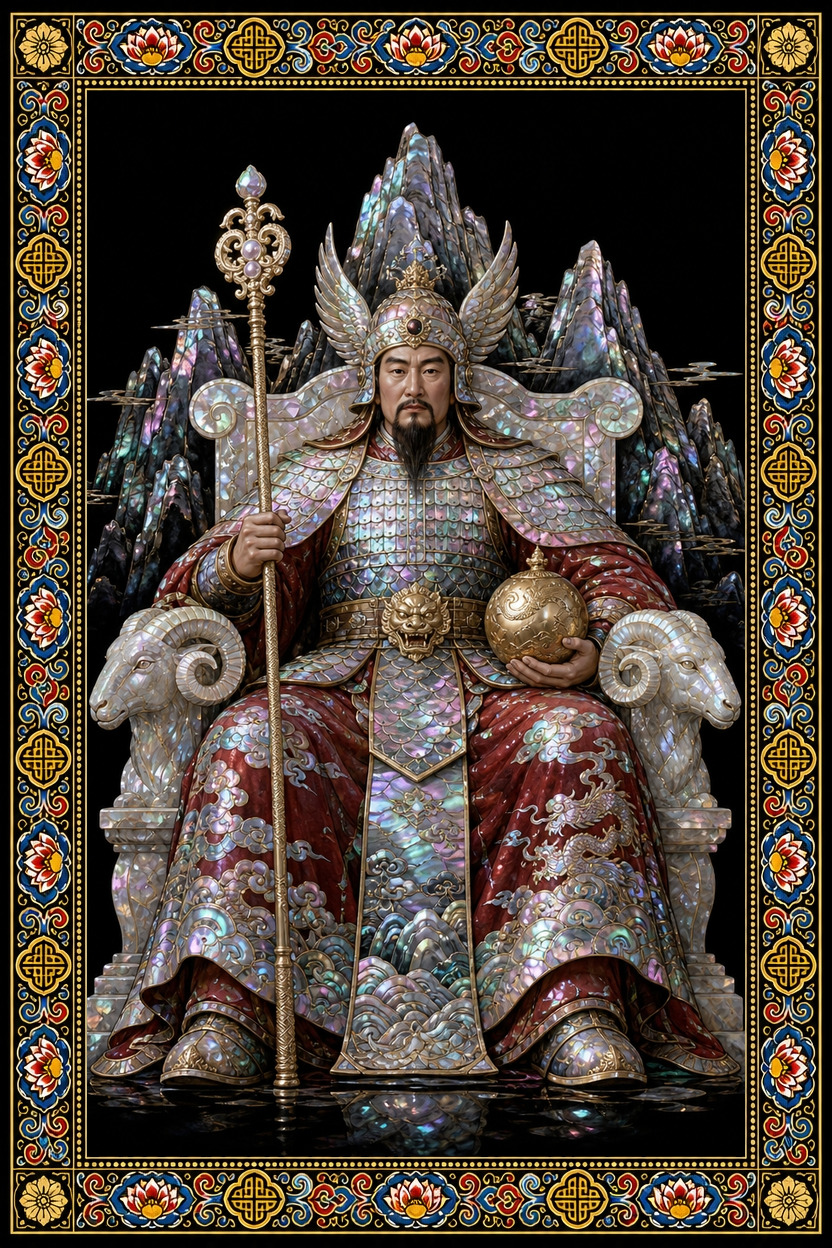
The Emperor — a king in red lamellar armour on a ram-carved throne
What is the king on the throne holding onto? This piece follows the details of the picture one by one and unpacks what the Emperor says about structure and control.
『The Emperor』 — what this card actually draws
At the centre of the image a bearded king sits on a throne made of stone. On his head is a helm with winged ornaments, and over his body he wears red lamellar armour. The throne is angular, with rams carved into the backrest and the armrests.
The king's hands are not empty. In one he holds a sceptre upright, and in the other a golden orb, kept close to his knee. His feet rest side by side on the ground, and his gaze faces straight ahead.
Behind the king, mountain peaks rise in layers. With the throne and the mountains placed together, the figure stands in front of the background and the background rises above the figure. The image shows a state fixed and unshaken.
Symbols and meaning
The stone throne means a seat that does not shift. It reads as meaning that the person seated there does not move this way and that with emotion but makes judgments from a set position. The ram carvings stand for a force that pushes forward, and that force is carved inside the hard material of stone.
The sceptre and the orb serve different roles. The sceptre is the authority to make decisions and set direction, while the orb is the tool for governing so that those decisions remain in real form. In the figure holding both objects together, we can see discipline and responsibility gathered in one person.
What a reversed reading attends to is the shadow of the same elements. The firm throne becomes stubbornness, and the hand gripping the sceptre becomes a hand trying to grip what belongs to others as well. Where discipline disappears, only impulsive domination remains. So the reversal should be treated as a question of how power is used, not of how much of it there is.
When this card appears
At work it signals that it is time to set standards and procedures. If someone keeps putting off a decision, it reads as a sign that the person who will take responsibility needs to be settled. Conversely, if there are already too many rules, it is also a card that asks what should be taken away.
In relationships it becomes a story about making the shape of a commitment clear. It means a conversation is needed to set roles and boundaries between people who have been running on feeling alone. With money it leans toward setting a framework for budget and spending, and with choices toward reaching a conclusion rather than dragging things out.
The Emperor tends to arrive as a demand rather than a suggestion: what you need now isn't a better idea — it's the rules to run that idea on. Structure first, inspiration after. "Give that idea a spine before you give it a voice."
History and culture: the 1909 Rider-Waite-Smith deck and the standardisation of symbols
The change worth noting in the Rider-Waite-Smith deck, published in 1909, is that what the figure is doing became the basis for interpretation. Pamela Colman Smith drew the cards under the direction of Arthur Edward Waite, and as a result the movements of hands and feet on each card came to carry meaning.
In the Emperor, the place where that change shows most clearly is the two hands. The Emperor of earlier decks existed only as a badge of authority, but the king in this deck performs concrete actions, raising the sceptre and gripping the orb. What he holds and how he sits changed the questions the reader asks.
For this reason, when interpreting this card, you look at the posture before the list of symbols. The story goes that the habit of checking where the hands point and whether the feet touch the ground became the way of reading after 1909.
Common misreadings
Some people conclude that when the Emperor appears, a powerful person is about to show up. But this card speaks of the need for structure rather than the arrival of a figure. Often it points to a state in which it has not been sorted out who holds authority.
It is also a misreading to assume that because it is a strong card it can only mean a good outcome. The reversed meaning is another face of the same picture, not a separate card. A state frozen by excessive control is also a legitimate position of this card.
Conversely, there is a view that sees this card only as cold and emotionless. The person on the throne is drawn as a being who does not push decisions onto others but takes responsibility in their own place. What temperature that responsibility is used at is filled in by the reader's own situation.
Draw a card yourself
The picture you have just read can be placed against your own question. The same card answers differently when the question changes.
- A deck drawn in-house — 78 cards in the colours of nacre and dancheong
- Readings that read the picture, not a keyword list
- Keep asking — draw one more card for your next question
- A record you can return to and compare
- Let a friend draw for you with a single link
- Seventeen languages, one deck, one reading
More from this suit
