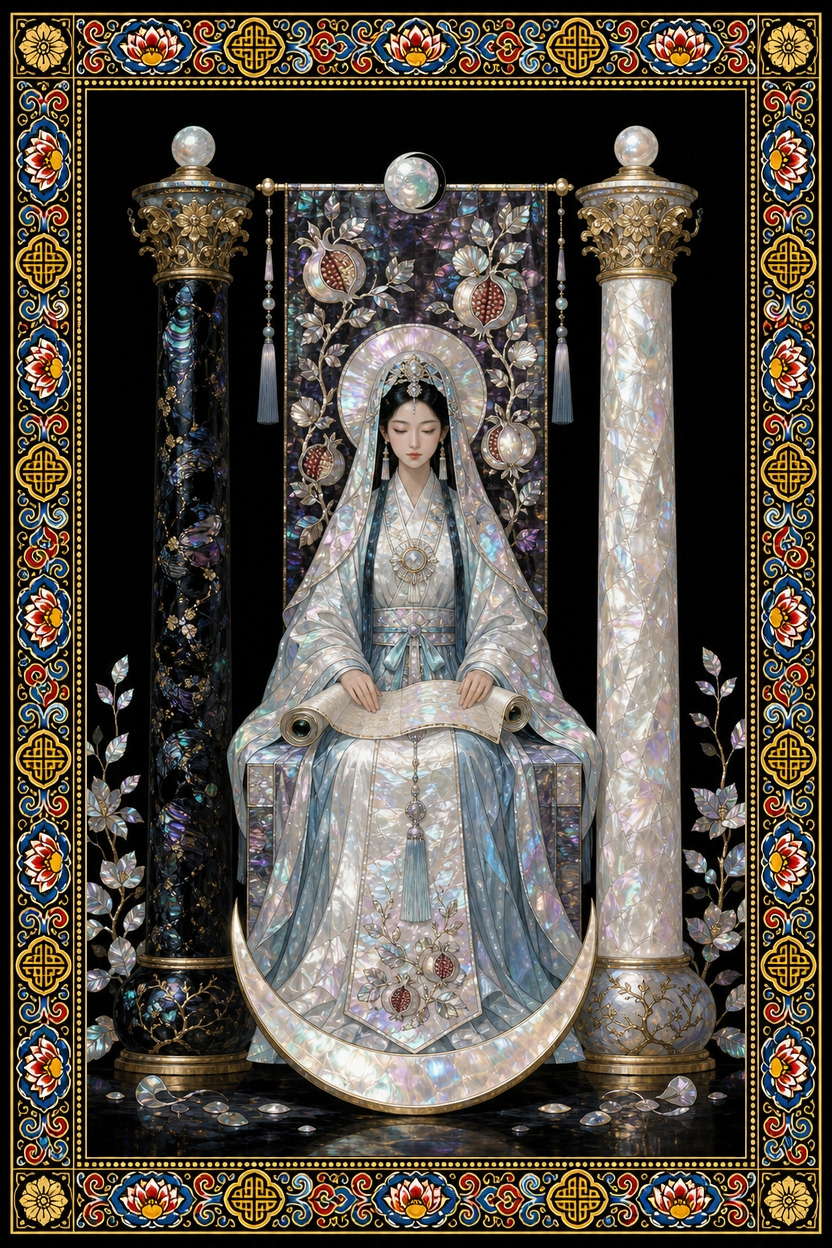
Major Arcana · The High Priestess
The High Priestess — The Woman with the Scroll Between Two Pillars
Why does the woman seated between the two pillars hold her scroll open and say nothing? Following the arrangement of the picture, this piece draws out the wisdom of silence that The High Priestess speaks.
『The High Priestess』 — what this card actually draws
At the center of the picture sits a woman in blue-white long robe (traditional dress), wearing a headdress. To her left and right stand a black pillar and a pale pillar, one on each side, and the woman occupies the space between them, facing forward. The eye is drawn naturally to the gap the two pillars make, the very place where she sits.
In her hands she holds an open scroll. At her feet lies a crescent moon, and behind her head a pearly halo spreads outward as if diffusing. White blossoms open to one side, giving the scene a quiet impression that is nonetheless not empty.
In this picture the woman does not explain anything or gesture. She simply sits with the scroll open, and that silence is what decides the card's first impression. It is a picture in which what is not said is placed as importantly as what is shown.
Symbols and meaning
The seat between the black pillar and the pale pillar signifies the boundary of two worlds. The woman belongs to neither side and stays between them, which symbolizes a place that moves back and forth between what is shown outwardly and what is concealed. That is why The High Priestess upright is read through intuition, the subconscious, and stillness.
The open scroll means knowledge not yet read. Yet that knowledge is not given from outside; the woman herself is holding it, and the crescent moon at her feet adds the quality of waiting for a cycle and its time to ripen. The halo behind her head and the white blossoms show that this silence is not coldness but a state of fullness.
Reversed, the same picture shows a different face. It reads as a state of holding the scroll but not opening it to read, that is, ignored intuition and a disconnection from the self. When the place between the pillars becomes avoidance rather than boundary, it leads to the meaning that only hidden agendas or surface knowledge remain.
When this card appears
At work it reads as a signal to put off judgment and look further into the situation rather than rush. The subtle mismatch between the data and the people may not yet have been put into words. In relationships, pay attention to the aftertaste a person's words leave rather than to the words themselves.
With money it is used to mean looking at the currents beyond the visible numbers. Putting off a big decision when you are not certain is also the way this card recommends. At a moment of choice, check the sense you already had before the answers others offer.
When the High Priestess surfaces in your spread, she asks you to hold the question open rather than rush it shut. Precision belongs to the inquiry now, not the verdict. You might hear it said plainly: "Now is not the time to settle on an answer, but to grasp the question precisely."
History and culture: the Visconti-Sforza deck and the Milanese court
In the gold-leaf deck made for Milan's ruling family in the 1440s, what is worth noticing is the object the figure holds. On costly handcrafted cards, a scroll or a book was often used as a mark of learning and authority, and was also a device for engraving the owner's cultivation onto the card.
The story goes that the cards of this deck drew court portraits, coats of arms, and scenes of ceremony into the picture. The scroll the High Priestess holds can be read within that current as well. The very fact of holding a sheet of paper reflects the world of those who could commission and own such a thing.
In an age when cards were the possessions of nobles, a scroll was not an object anyone could open. So this object carries the sensibility of a time when knowledge was costly, and that materiality remains quietly present when we read this card today.
Common misreadings
Many assume that when The High Priestess appears it hints at a secret or something hidden. But the woman in the picture is not silent in order to conceal; she is simply holding something that has not yet become words. The reversed card, too, need not be narrowed to a signal demanding confession or exposure.
Another is the view that treats this card only as passive or as avoiding decisions. The seat between the two pillars is not a place where nothing is done but a place from which both sides are watched at once. Intuition is closer to another name for observation than to laziness.
Finally, there is the misreading that takes The High Priestess as a mark of mysterious powers. What is in the picture is only symbols such as the halo, the crescent moon, and the scroll, and this card points not to a special talent but to an inner sense that everyone has.
Draw a card yourself
The picture you have just read can be placed against your own question. The same card answers differently when the question changes.
- A deck drawn in-house — 78 cards in the colours of nacre and dancheong
- Readings that read the picture, not a keyword list
- Keep asking — draw one more card for your next question
- A record you can return to and compare
- Let a friend draw for you with a single link
- Seventeen languages, one deck, one reading
More from this suit
