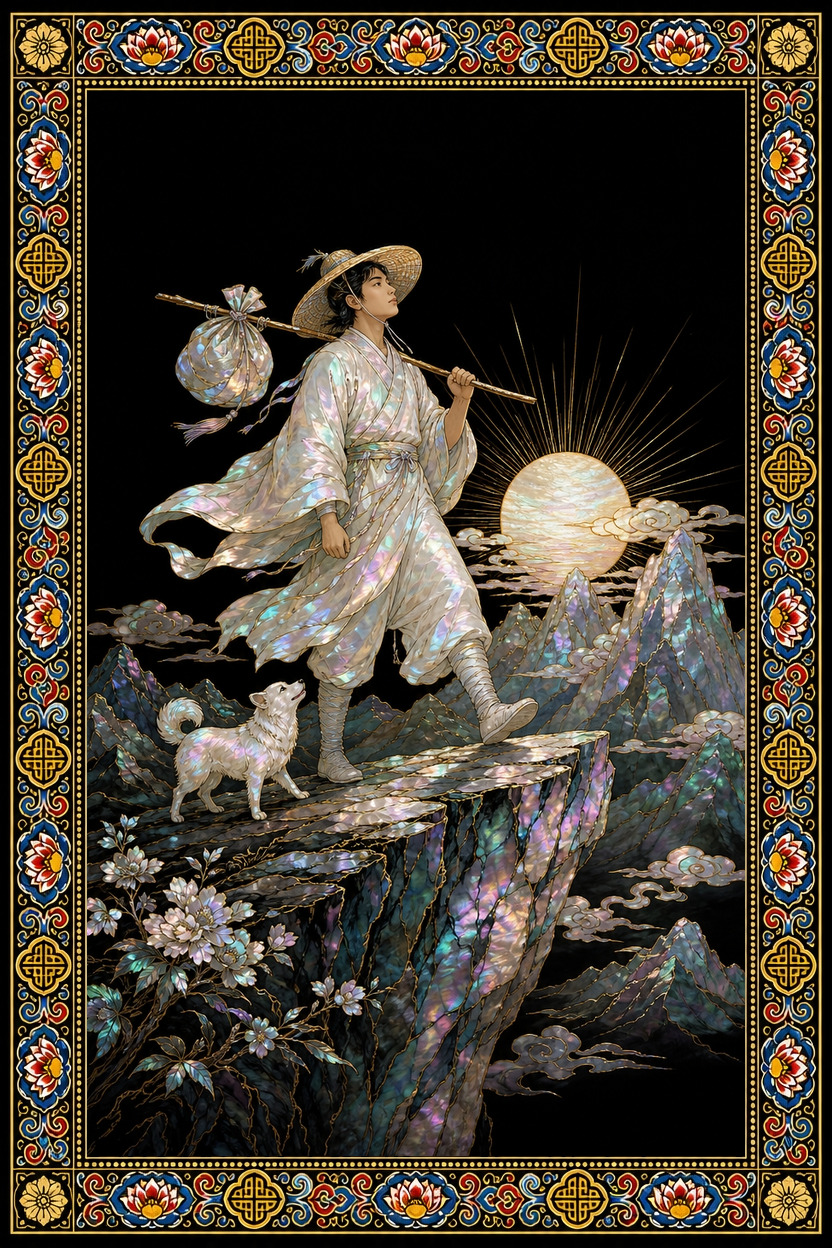
Major Arcana · The Fool
The Fool — A traveller at the cliff's edge, bundle tied to a staff
What comes to mind when you see someone stepping off the edge of a cliff? This piece follows the Fool's picture element by element, looking at how beginning and hesitation come to sit on the same card.
『The Fool』 — what this card actually draws
Your eye goes first to the lower part of the image, to the young traveller standing at the cliff's edge. He wears a white short jacket (the short jacket of long robe) and trousers, with a wide-brimmed satgat (a conical straw hat) pulled down on his head, and a staff with a bundle tied to it slung across his shoulder. Beneath his feet the ground runs out, and he stands on that boundary.
Beside the traveller a white dog keeps pace. It neither runs ahead nor falls behind but stays level with his stride, and its gaze follows the direction he faces. Moving up the image, there are peaks, and above them a pale sun is rising.
Finally the white flowers clinging to the crevices catch your eye. They are a small point blooming between hard stones, and unlike the other elements of the picture they sit where they do not move. These three masses — the person at the boundary, the dog that follows, the rising sun — are the frame of the picture.
Symbols and meaning
The cliff's edge is the point where safe ground ends. Yet the traveller stands facing forward without looking back. This posture creates the upright meaning. Not certainty but a body tilted toward taking the step — that is the beginning this card speaks of.
The staff with the bundle tied to it is both luggage and walking stick. The attitude of someone who has not packed everything he owns but has tied up only as much as he needs reads as spontaneity and freedom. Seen the other way, the same elements work differently. What surfaces is the recklessness of not looking at the cliff, or the hesitation of being unable to lift a foot from the edge.
The white dog plays a role in this picture as important as the person's. The dog is a being that moves its steps alongside the one looking ahead, and it creates the sense of not being alone. The sun rising over the peaks is a faint light before direction is settled. Remember that the brightness is not confirmed but only just coming up.
When this card appears
At work it reads as a situation where you have to move even though preparations are not finished. Rather than starting once the proposal is complete, a way of fixing things as you walk suits it better. Still, it is worth checking once what lies below the cliff.
In relationships it points to a connection not yet defined, a meeting before it has a name. The attitude of not assuming you know the other person and learning them one step at a time fits well. With money, small attempts suit better than large outlays, and this is not a judgment worth staking your whole fortune on.
Before a choice, the greater risk may be wearing yourself out waiting for a perfect answer—so consider taking the first step with only what you have now and filling in the rest along the way, the way the Fool walks off the cliff's edge without a map. When this card lands in your spread, it tends to speak plainly: "For now you only need to set a direction, not a certainty."
History and culture: Marseille tarot and the fifteenth-century card game
The element worth noting in this card's picture is the staff the traveller holds. The Fool of the Marseille tarot is often drawn holding a staff or walking stick, and this object functions like a marker of a person on the move. Before the cards became a divination tool, pictures like this were a scene in a game.
The deck is usually said to have started as a trick-taking game in northern Italy and to have been standardised in Marseille, France. The game was called tarocchi, and players competed with the cards. The Fool was a special card with rules different from the others.
The structure of twenty-one trumps plus one joker led to today's division between major and minor arcana. The Fool is the card standing in that joker's place, and in the game it was the exception that could overturn the board. A single card outside the rules has, in later hands, remained the freest of symbols.
Common misreadings
It is easy to misread the Fool as meaning someone who leaps in without a thought. But the figure in the picture is a person walking with a bundle tied to a staff. Seeing him not as planless but as equipped with the minimum of preparation is closer to the picture.
Another expectation is that this card is always positive. Placed reversed, the same cliff becomes a place of hesitation and points to a state of clouded judgment. Remember that the opposite meaning comes from the same picture.
Finally, there are cases where the Fool is used only as a byword for immaturity or frivolity. But this is a card that deals with a starting point whose order is not yet set. It is good to read it as a card summoned wherever a new round opens, regardless of age or experience.
Draw a card yourself
The picture you have just read can be placed against your own question. The same card answers differently when the question changes.
- A deck drawn in-house — 78 cards in the colours of nacre and dancheong
- Readings that read the picture, not a keyword list
- Keep asking — draw one more card for your next question
- A record you can return to and compare
- Let a friend draw for you with a single link
- Seventeen languages, one deck, one reading
More from this suit

