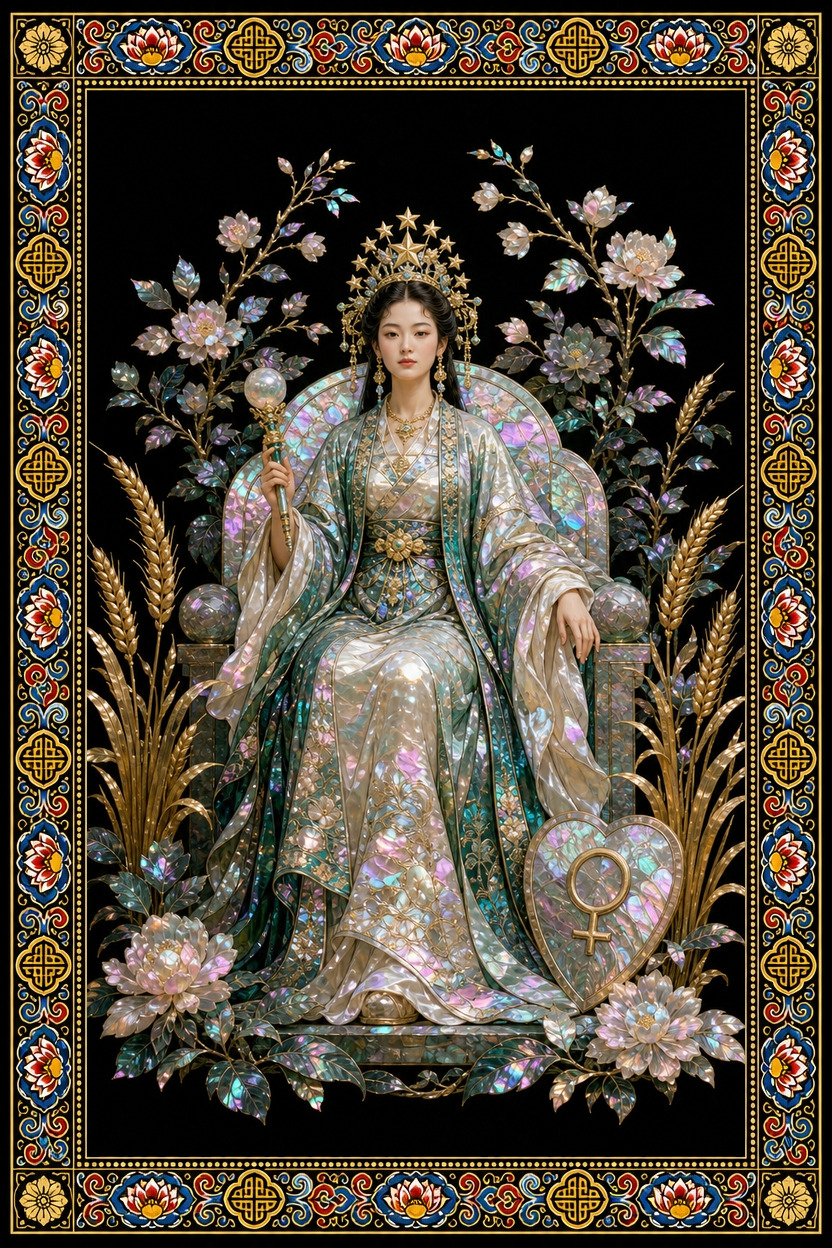
Major Arcana · The Empress
The Empress — A Heart-Shaped Shield Set Between Rice Ears and Peonies
Is abundance luck that simply rolls in on its own, or the fruit of time spent tending and cultivating? The picture on the Empress card quietly gives its answer through the arrangement of the rice ears and the shield.
『The Empress』 — what this card actually draws
At the center of the image a crowned woman sits on a throne. A single lotus blossom is held in her hand, and her gaze faces straight ahead. Rice ears line both sides of the throne, and fully opened peonies fill the space beside them.
Lower your eyes and a heart-shaped shield rests at her feet. The shield is engraved with the symbol of Venus. Follow what the figure holds and what she has set beneath her feet, and the composition of the picture comes into focus.
The lotus is in her hand, the rice and peonies at either side, the shield at her feet. What she holds, what she keeps close, and what she stands over each form a different layer. This arrangement decides much of the card's character.
Symbols and meaning
The hand holding the lotus stands for the channel through which sensuality and creativity flow out of the body. Rice ears are grain that has ripened and bowed its head, so they carry the meaning of a result matured over time. The upright card's abundance and productivity therefore read not as sudden acquisition but as the fruit of cultivation.
That peonies fill the left and right supports the card's sensual side. In East Asia the peony has long been painted as the flower of wealth and prosperity, and its splendor pairs with the humble rice ear. The heart-shaped shield at her feet and the Venus symbol tell us that all of this rests on affection and care.
Reversed, the same elements show another face. The rice stands unripened and the lotus lingers only in the hand, drawing creative block and stagnation. Care can tip into overprotection that clutches at the other person, or, in the other direction, into self-neglect, the failure to care for oneself.
When this card appears
At work it reads as a time to harvest what you have made. Work prepared over a long time takes shape, or a project you have tended bears fruit. Still, respect the time it takes to ripen rather than rushing it.
In relationships the balance of care becomes the question. It is worth checking whether consideration for the other person is spilling into overprotection that takes over their share. With money, spending and the senses are linked, so outlay on the things you love may grow.
Before a choice, take note of the direction your body leans first. This card puts the senses ahead of logic, so while a decision is being postponed, observing where your body tilts can help.
"It seems this is a time to tend once more to what is already in your hands."
History and culture: minhwa and sipjangsaeng — the lineage of symbolic creatures
In this card's picture, the element closest to East Asian symbolic history is the rice ear. In the flower-and-bird paintings of minhwa, setting grain and flowers side by side is a common composition, and it carries a wish for abundance. Rice bowing its head has been read as an expression that conveys both ripening and humility.
Rice does not appear on the list of sipjangsaeng, but the direction that system points in is clear. Just as the sun and mountains, water and clouds, the sonamu (red pine) and the herb of immortality, the crane, deer, turtle, and bat each took charge of long life and blessing, so rice and peonies each take charge of a different layer of abundance. The story goes that the peony symbolizes wealth and the rice ear the foundation of daily sustenance.
What is interesting is that minhwa did not build its symbols from animals alone. From the books and objects of chaekgeori to the beasts of the magpie-and-tiger paintings, every thing in the picture shares in the meaning. The lotus and shield of the Empress can be seen in the same way, as a composition that parcels out the figure's character among the objects.
Common misreadings
Some expect that when the Empress appears, good things will simply happen on their own. But the rice in the picture is a grain that takes time to ripen. Rather than promising abundance, this card shows the condition that fruit comes only when there is a process of tending and cultivating.
Because it is a card of nurturing, some think only of the ever-indulgent mother figure. In fact, the reversed card also deals with care gone astray, such as self-neglect or overprotection. Read alongside it the point that care also includes drawing boundaries.
Some see a card of the senses and take it to mean only spontaneous pleasure. In the picture, the senses are bound to affection through the lotus, the peonies, and the shield at her feet. The card's meaning becomes whole when the senses' pull toward pleasure settles within relationship and responsibility.
Draw a card yourself
The picture you have just read can be placed against your own question. The same card answers differently when the question changes.
- A deck drawn in-house — 78 cards in the colours of nacre and dancheong
- Readings that read the picture, not a keyword list
- Keep asking — draw one more card for your next question
- A record you can return to and compare
- Let a friend draw for you with a single link
- Seventeen languages, one deck, one reading
More from this suit
