Major Arcana · The Hierophant
The Hierophant — Two Fingers Raised in Blessing and Lotuses on the Water
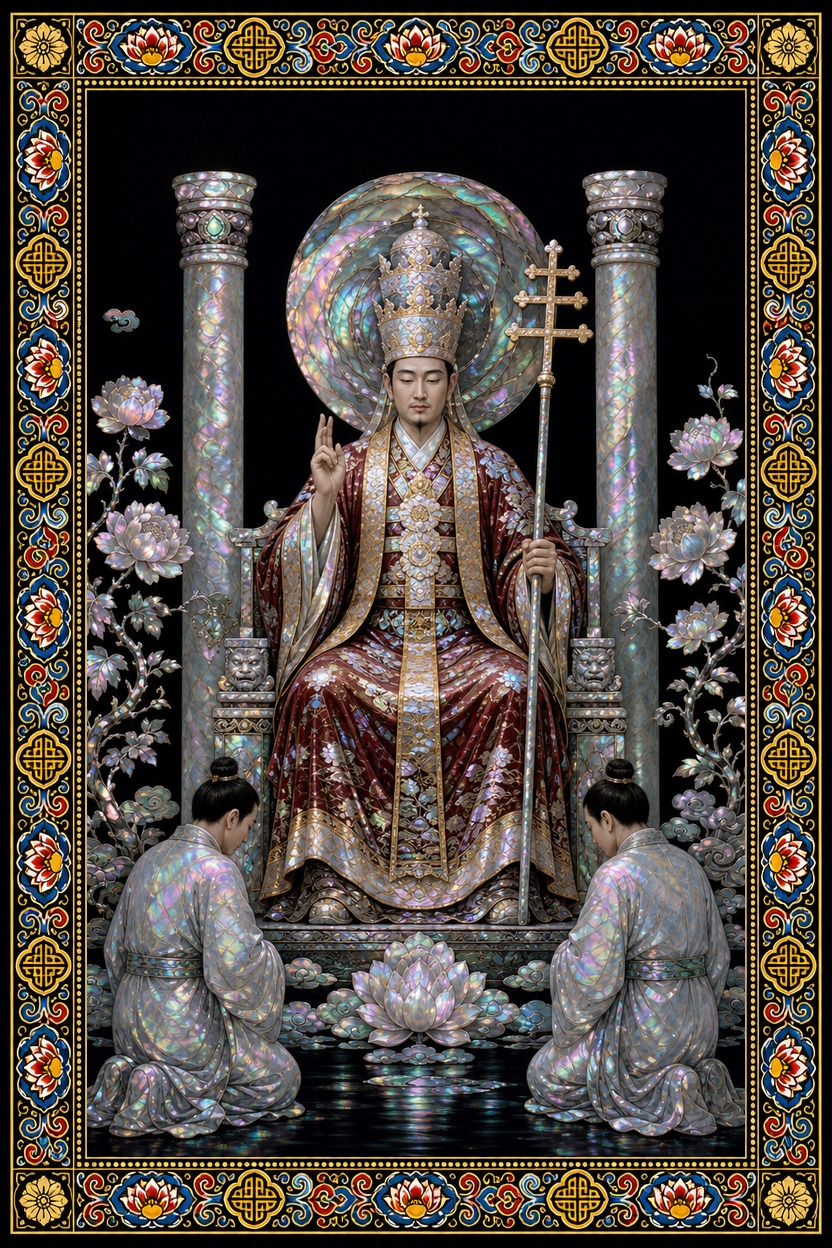
Why does the teacher raise only two fingers and say nothing? This piece follows the order of the Hierophant card's image and asks where tradition and guidance come from.
『The Hierophant』 — what this card actually draws
In the centre of the card sits a figure wearing a crown that glitters with gold and silver ornament. In one hand he holds a staff topped with a cross planted upright; the other hand is raised with two fingers extended toward the front. The crown and the staff catch the eye first, and then the gaze moves to the raised fingertips.
Beyond those fingertips, with the water between them, two figures in pale robes kneel. Lotuses float on the water, and behind the two figures stand pillars and peonies. The water placed between the teacher and the two people creates the distance of this scene.
The image shows the place where teaching passes from one to another, head on. It is not a scene of speech, nor of an open book; the relationship is settled by a single gesture and a single kneeling. So this card asks first who learns from whom, rather than what is being taught.
Symbols and meaning
The two raised fingers are closer to a gesture of approval than of explanation. The staff and the crown reveal that this seat is not a person's improvisation but something built up over a long time. So the Hierophant upright reads as a situation of being guided along a road someone has already walked, which is to say mentorship and shared values.
The water and the lotuses hint that this authority has not hardened. The two kneeling figures are side by side at the same height, and the teacher is only ahead of them. Tradition appears here not as a command but as a form that is handed over.
Lay the card reversed and the same image reads as stifling. The blessing gesture feels like a condition rather than a permission, and the place across the water becomes a boundary that can never be crossed. The Hierophant now leans toward questioning convention, toward restriction, toward breaking the rules.
Rebellion for its own sake is another matter, though. When you can say what you are refusing and why, that doubt becomes your own judgement, distinct from dogma.
When this card appears
At work it reads as a sign that there is someone to learn from. Rather than deciding fast on your own, try following once the procedure of someone who has already done the job. If the rules inside an organisation feel stifling, it is better to check first when and why those rules came about.
In relationships the question becomes whether the two of you share a common promise. If you come from different backgrounds, talk about how far you hold the same values. With money, proven methods and documented procedures become your strength, and before a choice you weigh old standards and present needs side by side.
The Hierophant puts you on the spot about authority: what you are refusing — is it the rule, or the people who keep it? Sit with the difference before you answer, because the card rarely lets you off with a shrug. "Try to tell apart what you are refusing — is it the rule, or the people who keep it?"
History and culture: Traditional dress — silhouette, colour and station
What stands out in this card's figure is the silhouette of an outer robe spreading wide and the crown wrapped around the head. In Joseon-era dress, this layering and ease was a device for showing station and ceremony rather than for decoration. Wide garments such as the long coat (a scholar's long coat) or official robes restricted movement, but in exchange they announced first where the wearer stood.
Colour and material played the same role. The colour of a garment changed with official rank, and materials such as hemp and silk showed value, season, and the wearer's circumstances together. In the later Joseon period, by contrast, commoners' dress moved toward practicality. The short jacket (the short jacket of long robe) grew shorter and trouser legs were trimmed — adjustments fitted to a body at work.
In the end the silhouette of a garment records two directions at once: wide at the seat of ceremony, narrow at the seat of labour. If this card's teacher wears a wide outer robe, that is a sign telling you his seat is on the ceremonial side.
Common misreadings
Some people conclude that when the Hierophant appears, it means believe in religion or authority. But the centre of the image is not the content of belief but the hand that is extended. This card asks from whom you are learning and what, rather than what you believe.
Reading the reversed card as nothing but escape or transgression is also hasty. The two figures across the water are still kneeling where they are. They are in a state of doubt, not a state of having left, and how you handle that gap remains the real task.
People also fix this card as an old man who always holds the right answer. The teacher in the image does not speak; he only gestures. Guidance is closer to preparing a place for a question than to giving an answer.
Draw a card yourself
The picture you have just read can be placed against your own question. The same card answers differently when the question changes.
- A deck drawn in-house — 78 cards in the colours of nacre and dancheong
- Readings that read the picture, not a keyword list
- Keep asking — draw one more card for your next question
- A record you can return to and compare
- Let a friend draw for you with a single link
- Seventeen languages, one deck, one reading
More from this suit
