Major Arcana · The Chariot
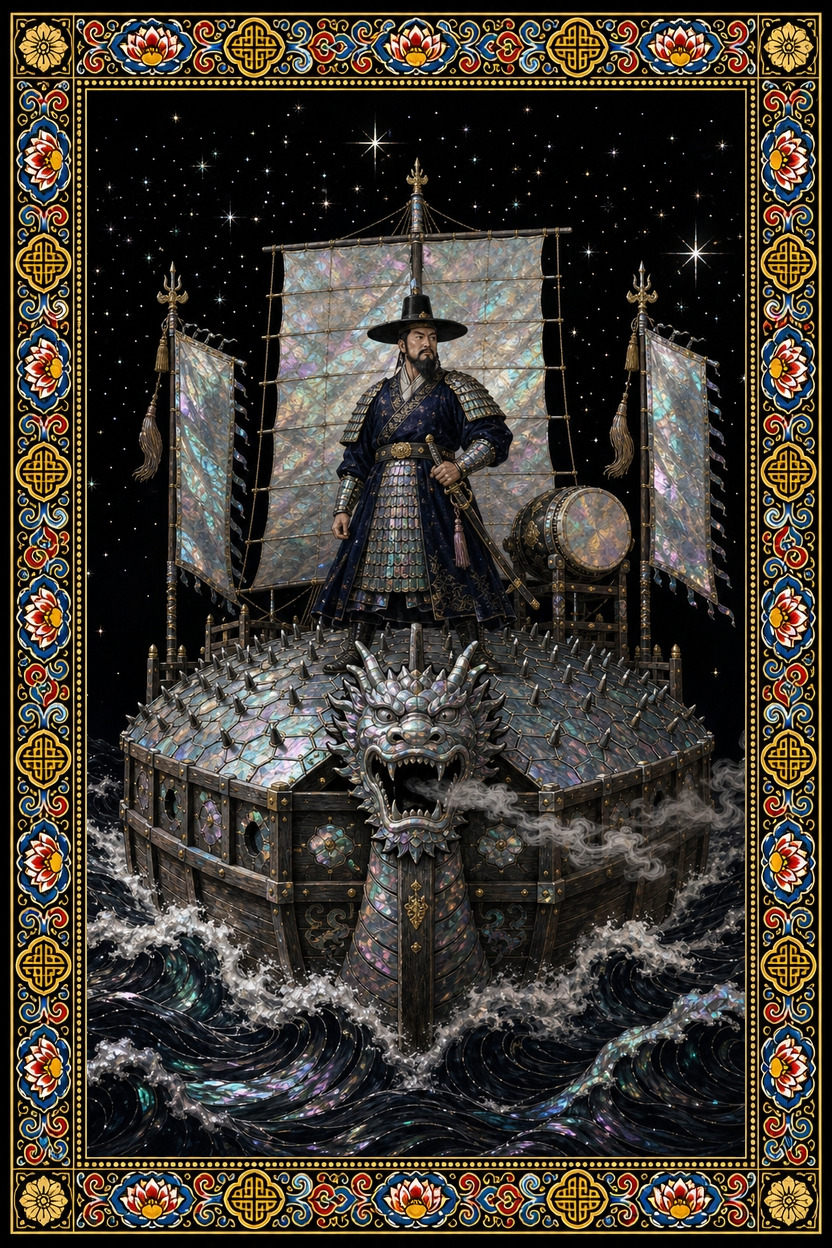
The Chariot — A Commander Aboard a Dragon-Prowed Ship on a Starry Sea
Where is the commander standing on the deck heading? This piece follows the Chariot's visual elements one by one and reads its two faces: will and the loss of direction.
『The Chariot』 — what this card actually draws
The eye first lands on the commander, armored and wearing a gat (a wide-brimmed black horsehair hat). He stands straight on the ship's deck, and the planking beneath his feet takes the form of a turtle ship with a dragon's head at the prow. He is neither seated nor leaning. The standing posture itself is the center of this picture.
Behind him spread nacre sails and a flag. The sails are swollen with wind, and the flag, too, stretches toward the direction of travel. Beside the deck lies a drum. It has not sounded yet, but it looks like an object poised to give a signal at any moment.
The ship moves over a night sea full of stars. The sky is thick with them, and the waves run on as if opening the way ahead. Nowhere in the frame is there a trace of anchoring or standing still. This picture catches not a departure but a moment already under way.
Symbols and meaning
Upright, what this picture says is determination. The commander planting both feet on the deck reads as keeping his center even on shifting water. The sails and flag stretching in the same direction mark force gathered into one place. That is what willpower is: when the mind does not scatter along several branches but faces one direction, the ship moves forward.
Reversed, the same picture is lit differently. The commander still stands, but if the sails fail to catch the wind properly, the ship can circle in place. A drum that lies there without sounding—that is the face of lost direction. This card points to the case where you cannot advance not because strength is lacking but because it is scattered.
The phrase self-control comes from here too. No oars and no rudder are visible on this ship. It means the commander steers with his body. So the momentum of this card is closer to the power to regulate your own inner speed than to the power to push others.
When this card appears
At work, it signals the moment to push ahead. If there is a decision you have long postponed, set a direction now and move. Still, it is better to check the direction before the speed.
In relationships, it turns you back to ask who holds the key to the emotions. If the wish to outrun the other person comes first, only the drum is loud and the ship does not go. With money, the task that surfaces is to gather the flow of spending into one direction.
At a moment of choice, do not try to open every door at once. Better to choose one and set your sails toward it. When the Chariot pulls into your spread, it asks you to gather the reins and drive one road hard: "Now is not the time to add to your worries but to narrow them to a single direction."
History and culture: figures East and West — immortals, emblems, diagrams
In East Asian paintings of immortals, the figure usually floats between heaven and earth. With clouds underfoot or seated on a rock, the figure exists at a rhythm different from the world's pace. The gaze goes not straight ahead but obliquely upward, and a fan or staff rests in the hand. The figure's posture itself explains the world he belongs to.
European emblem books are another matter. The figure stands bearing symbols on the body, and a short motto beneath the diagram fixes the meaning. Astrological diagrams, too, draw the figure in a fixed posture tied to a constellation. Image and text pair up to complete a single lesson.
The Chariot's commander stands between these two. Unlike an immortal he does not float but plants both feet on the deck, and like an emblem figure he wears his attributes, though the drum is set beside him rather than held. The posture is fixed, but the gaze faces where he is going. This is the point where the Eastern and Western ways of setting a figure in a diagram overlap in a single frame.
Common misreadings
The Chariot is often read as a card that guarantees victory. But what is in the picture is not victory but a voyage. That the ship is moving and that it has reached its destination are different things. This card speaks of movement; it does not promise an outcome.
Another misreading is that this is a card of the strong. It is more natural to see the armor not as a display of strength but as gear for not losing your center on the water. Control is not the erasing of emotion but keeping your place even when shaken.
Nor need you conclude that you must stop just because the card comes up reversed. It is enough to take it as a signal to check the direction of the sails again. Slowing for a moment and sounding the drum once—that is the next step this card recommends.
Draw a card yourself
The picture you have just read can be placed against your own question. The same card answers differently when the question changes.
- A deck drawn in-house — 78 cards in the colours of nacre and dancheong
- Readings that read the picture, not a keyword list
- Keep asking — draw one more card for your next question
- A record you can return to and compare
- Let a friend draw for you with a single link
- Seventeen languages, one deck, one reading
More from this suit
