Major Arcana · Wheel of Fortune
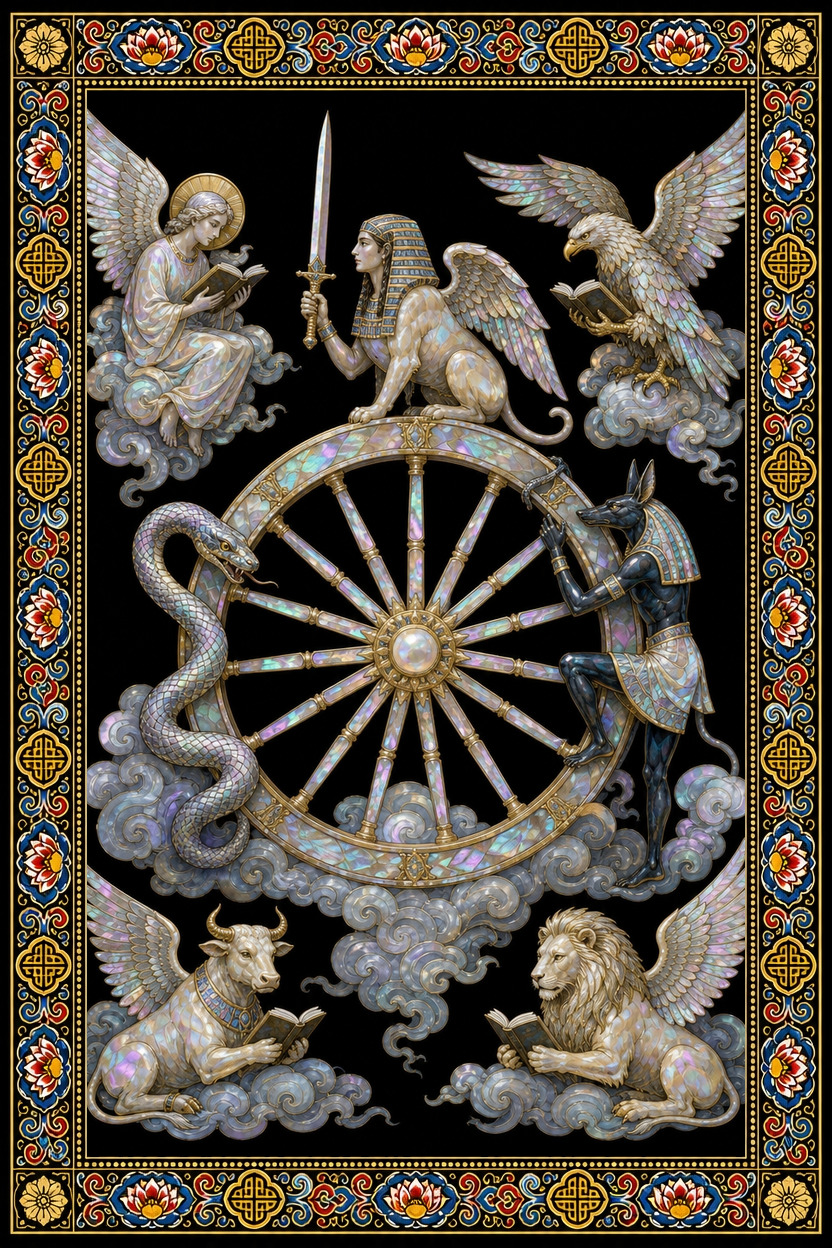
Wheel of Fortune — A Sword-Bearing Sphinx Atop the Twelve-Spoked Wheel
Why was the wheel drawn with exactly twelve spokes? This essay follows the arrangement of the image and the grammar of its numbers to examine the kind of change this card describes.
『Wheel of Fortune』 — what this card actually draws
Your eye goes first to the centre of the image. A great wheel of gold and nacre rests in the clouds, and twelve spokes radiate outward along its rim. The wheel is a still picture, yet the arrangement of the spokes alone suggests it is a thing that turns.
At the top of the wheel sits a sphinx holding a sword. To the left of the wheel a serpent slides downward, and on the right a dark jackal figure clings to the wheel. Three beings thus take their places above and on either side of it.
At the four corners of the image, different figures sit holding books. These are an angel, an eagle, a bull and a lion, and they surround the wheel with their books open in the clouds. The order of reading the picture moves naturally from the wheel at the centre out to the four corners.
Symbols and meaning
The wheel drawn with twelve spokes shows visually that time does not stop but turns in cycles. Upright, this card reads as a signal that the current is already moving. The situation is not fixed, and the present phase too will pass into the next.
The sphinx at the top symbolises an attitude that does not lose its centre wherever the wheel may be. Reversed, by contrast, the card comes closer to a figure clinging to that same wheel and being dragged along. It reflects a state of refusing the downward flow, as the serpent slides down, and circling in the same place.
The four beings at the four corners are the gaze of observers watching the wheel turn. That they hold books hints that change is not chance but a process that is recorded and read. So this card holds good fortune and bad together, and asks what attitude you take toward reading the flow.
When this card appears
In work, it tells you that a phase you have held onto for a long time may reach a turning point. A trigger from outside, such as a change of job or of role, can shift the flow, so do not judge by your present position alone.
In relationships, it suggests that the phase between two people may turn out differently from before. Do not grow careless even in good times, and in hard times remember that they are not permanent. With money, regular check-ins and record-keeping help you keep hold of the flow.
When the Wheel of Fortune turns up at a moment of choice, look first at where the wheel stands now rather than at which side is right. What matters is sensing the direction of the turn before you commit your weight to it. So the counsel you'll hear is this: "This is not the time to push, but the time to check where the flow is turning."
History and culture: the old grammar of number and figure
The number 10 of this card was regarded in medieval European number symbolism as the number that completes a cycle. The story goes that the Pythagoreans explained 10 as the sum of 1 through 4, and so 10 was read as the threshold of returning to 1. The idea of a turning wheel and the character of this number overlap naturally.
The arrangement of the four corners around the wheel follows the grammar of the number 4. Like the four directions and the four elements, 4 was used as a basic unit for dividing the world, and in East Asia too the four quarters and four seasons were grouped to explain the world. That the angel, eagle, bull and lion are placed at the four corners shows that these four are the frame enclosing the wheel's turning.
Twelve is 3 multiplied by 4, long used as a unit for dividing time and the seasons. The twelve-spoked wheel thus becomes a figure resembling the cycle of a calendar. By number and arrangement alone, this card says that change does not turn at random but on a set grammar.
Common misreadings
Some conclude that great luck will soon arrive whenever this card appears. But the wheel in the picture holds the rising side and the falling side at once. The word turning point comes closer to this image than the word luck.
Reading it as confirmed misfortune is likewise an overreach. The wheel turns, so the present position only foreshadows the next. If it appears reversed, try reading it not as meaning there is no change, but as a signal to look at the attitude with which you are holding onto change.
Draw a card yourself
The picture you have just read can be placed against your own question. The same card answers differently when the question changes.
- A deck drawn in-house — 78 cards in the colours of nacre and dancheong
- Readings that read the picture, not a keyword list
- Keep asking — draw one more card for your next question
- A record you can return to and compare
- Let a friend draw for you with a single link
- Seventeen languages, one deck, one reading
More from this suit
