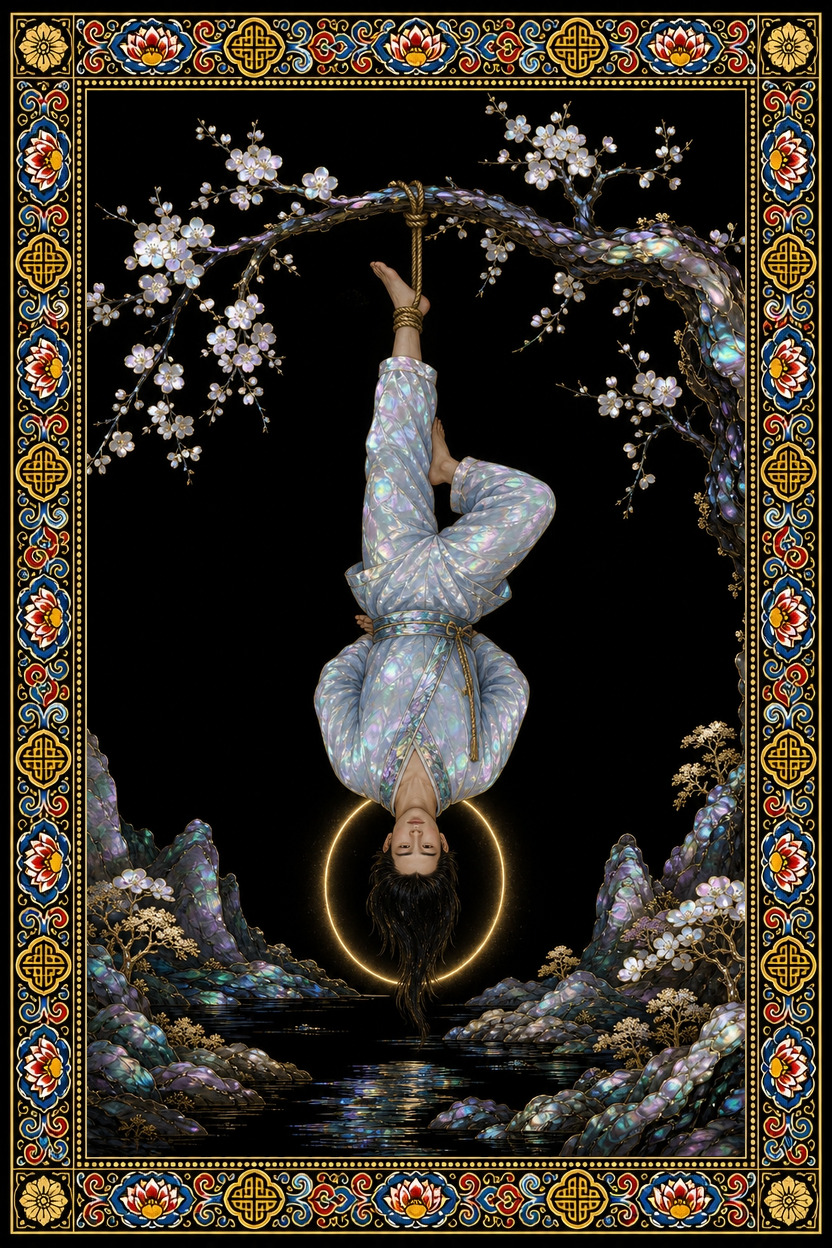
Major Arcana · The Hanged Man
The Hanged Man — One Ankle Tied to a Plum Branch, Hanging Upside Down
What is the figure hanging upside down, hands gathered behind the back, waiting for? This essay reads that pause not as failure but as a shift in how one sees.
『The Hanged Man』 — what this card actually draws
What fills the frame first is a branch of flowering plum. From it a figure hangs upside down by one ankle, the body drawn straight down. Where the toes point, dark water and rocks lie below.
The figure's hands are gathered behind the back. Only one ankle is bound, yet the hands do not try to steady the body. Around the head a golden halo spreads in a circle, and this light does not pour down from above but settles as if cradling the hanging head.
The eye travels naturally from branch to ankle, ankle to face, face to halo. Follow that order and the picture reads as a scene of stillness, not resistance. The hanged man is not someone about to fall; he is someone who has already stopped.
Symbols and meaning
The upside-down posture turns the whole direction of seeing the world on its head. What is invisible when you stand upright looks different when you gaze up from below. So this card speaks of a pause together with a new perspective. Because the figure does not move, the field of view changes.
Hands gathered behind the back read as a refusal to grab hold. The hanging body could be steadied by the hands, and is not, so this person has stopped bracing. Emptiness and letting go arise from a motion that releases effort like this.
Placed reversed, the same picture wears a different face. If the figure hangs kicking and shaking the branch, that is not a pause but resistance. It is the place where sacrifice repeats and nothing changes, and so stalling and indecision show through together.
When this card appears
At work it reads as a time when it is all right to set things down for a while. It is a signal to stop the work you were pushing for a day and look again not from above but from the side. In relationships, set aside for a moment the words meant to persuade the other person, and redraw the scene from where they stand.
With money, postponing a decision can itself be strategy. If it is a matter that need not be concluded right now, you may choose a delay. But if you are repeating the same loss in the same spot, that is not a delay but a habit.
When a choice holds you in place, you may keep circling both sides without landing on either. What The Hanged Man asks for then is not more information but a different angle on the board — the willingness to see from upside down. The frustration here is rarely the pause itself; it is refusing to admit you are paused. "What is frustrating is not that you are stopped right now; it is that you cannot admit you are stopped."
History and culture: najeon chilgi — inlaying crushed shell into lacquer
What stays with the eye in this picture is the golden halo wrapping the hanging body. Above the dark water and rocks that light spreads with unusual thinness and evenness. Recall the najeon chilgi craft of Tongyeong and Wonju and this texture is not unfamiliar. Nacre does not give off light of its own; it is a material that returns received light along its grain. In this deck that grain is painted, not inlaid.
Craftspeople saw thick shell into pieces and sand them thin to make nacre strips. They cut the pieces to a pattern and set them on bamboo or a lacquered surface, then coat and sand the whole many times until ground and nacre bond as a single face. Cutting, setting, and sanding do not finish quickly.
The lineage of patterns carried on Goryeo and Joseon najeon boxes rests on the same principle. Cutting vine and flowering branch and laying them on a wooden surface overlaps strangely with the composition of this picture hanging from a branch. The story goes that holding light in place gives way to letting it flow along the grain, and that this is why nacre was used for so long.
Common misreadings
Some take this card as a warning of loss or misfortune. But the figure in the picture is unharmed, and light lingers around the head. Reading the hanging as a posture of briefly entrusting the body, not a punishment, comes closer to the picture.
Another misreading is that this is a card of doing nothing. A pause is not the same as idleness. It is a choice to slow down on purpose in order to change direction, and in that time the field of view opens anew.
Finally, some read it as a card that romanticizes sacrifice. In the upright and the reversed alike, wasted sacrifice is something to watch for. Telling apart what to let go of and what to hold fast to is this card's real question.
Draw a card yourself
The picture you have just read can be placed against your own question. The same card answers differently when the question changes.
- A deck drawn in-house — 78 cards in the colours of nacre and dancheong
- Readings that read the picture, not a keyword list
- Keep asking — draw one more card for your next question
- A record you can return to and compare
- Let a friend draw for you with a single link
- Seventeen languages, one deck, one reading
More from this suit
