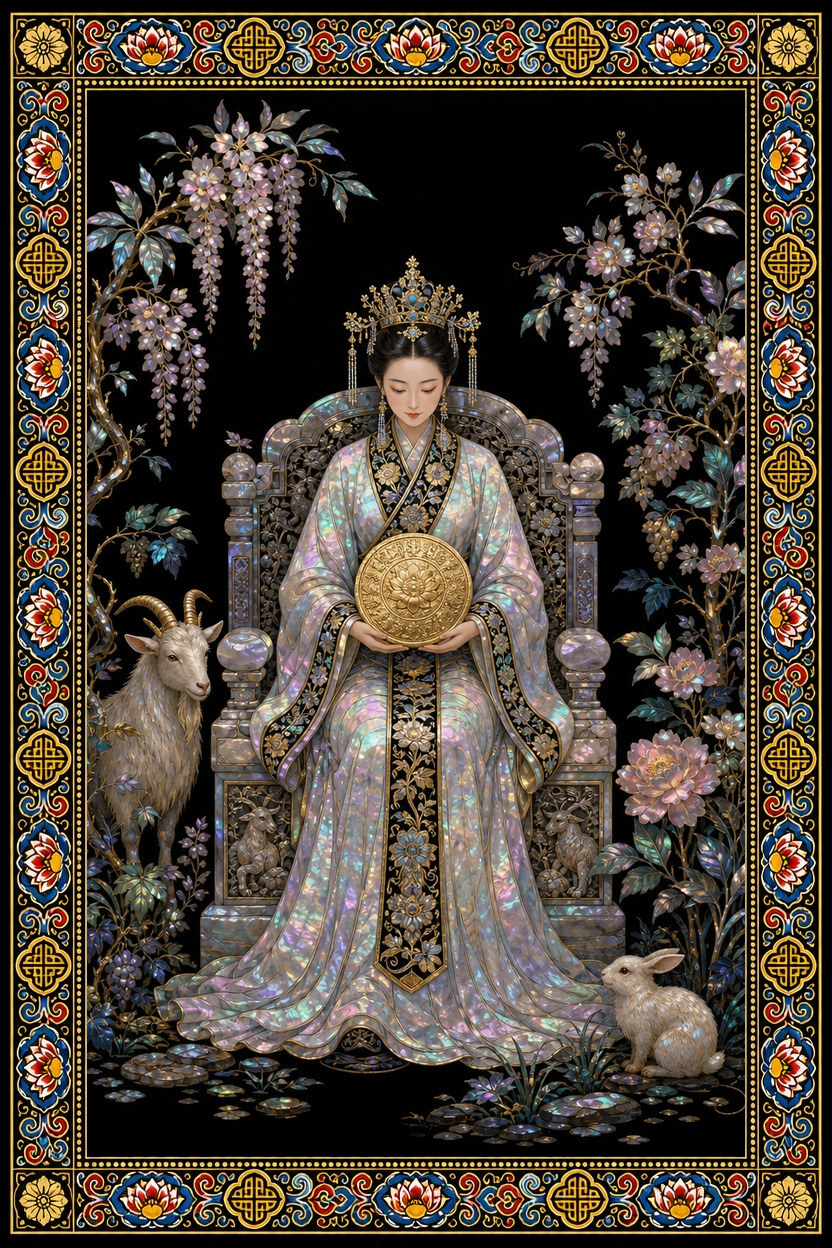
Pentacles · Queen of Pentacles
Queen of Pentacles — The Gold Coin on Her Lap and the Goat at Her Feet
Isn't it often the people most skilled at caring for others who push their own share to the back of the line? Following the picture on this card, let's look at how practical care becomes stability, and where it wears thin.
『Queen of Pentacles』 — what this card actually draws
At the center of the image sits a crowned queen. The throne she sits on is carved with floral patterns, and on her lap rests a single large gold coin. She neither clutches the coin nor lifts it; her hands rest near her knees.
Shift your gaze a little to the side and a goat stands beside the throne. Above the queen's head, wisteria and peonies hang down and fill the upper part of the image. It is a composition in which a person, an animal, and plants are placed side by side in one frame.
What the queen is doing in this picture is nothing special. Sitting and holding what she has — that is the whole of the scene this card shows.
Follow the arrangement with your eyes. The coin on her lap, the goat at her feet, and the vines above her head each wrap around the queen from a different layer.
Symbols and meaning
The posture of resting the coin on her lap is a picture in which ownership and care overlap. What matters is that she has not gripped it tight in her hand. Holding what you have while knowing how to let it go — that is the texture of the practical stability this card speaks of.
The goat at her feet reveals a nature bound to the earth. It reads as meaning that the queen's domain is not ideals aimed at the sky but the work of raising, feeding, and tending what lies right in front of her. The vines and flowers above her head show that this care is in a state of growing.
Placed reversed, the same picture becomes a different face. It reads as a state in which she keeps the coin on her own body while having no share for herself, a state in which her feet are tied caring for what is beside her. The amount of care is unchanged, but the strength that supports it has diminished.
So the reversed side of this card is closer to exhaustion than to coldness. It leads to the meaning that filling your own bowl first is not selfish.
When this card appears
At work, it reads as a time for steadily running what is already familiar in your hands. The emphasis falls on tending well the position you already hold rather than making a big new score. A role of looking after juniors or colleagues may follow naturally.
In relationships, the way you actually take care of things shows more than words do. Care in the form of fixing meals and organizing schedules becomes an expression of affection. But if the one line asking whether this is what the other person wanted is missing, it can remain as a burden.
In money, this is a time suited to managing rather than earning. Shoring up the foundations of daily life and plugging the leaks lead to results. Faced with a choice, it reads as a signal to first count whether you have room to spare right now.
In front of this picture, people often say something like this: "I keep thinking everyone would fall apart without me, and yet there's nothing left over for me."
History and culture: America, Britain and the modern tarot
What stands out on this card are the floral patterns carved into the throne and the vines hanging above her head. This composition, which layers plant ornament over the coronation imagery that signals a figure's authority, reads as an editorial intention to translate power not as force but as the work of cultivating.
As this deck spread widely in twentieth-century America and Britain, the details of the picture were reprinted over and over alongside guidebooks. In that process, ornaments such as flowers and vines became markers more than decoration, and readers took these elements as symbols of care and abundance.
From the 1970s onward, as tarot began to be read at the meeting point of psychology and the New Age, this card was used as a mirror reflecting the inner life of the "caregiver." Modern readings treat the queen carefully, not as an ideal type but as a task of balance.
Several stories are told about the path by which this card became popular in America, but the meaning of the plant motifs in the picture itself has not changed much across generations.
Common misreadings
First, there are cases where the appearance of this card is read as a guarantee of abundance. The picture is only of a single gold coin resting on a lap, and how to use it is still the business of the person sitting there.
Second, it is easy to assume that because she is a queen, this card applies only to women. In practice it is read as pointing to the situation of anyone, regardless of gender, who carries a role of care and management.
Third, some interpretations see the reversed card as the mark of a cold or selfish person. Since the elements of the picture are unchanged and only the strength has drained away, it is more faithful to the picture to see it as a signal of recovery rather than an ill omen.
Draw a card yourself
The picture you have just read can be placed against your own question. The same card answers differently when the question changes.
- A deck drawn in-house — 78 cards in the colours of nacre and dancheong
- Readings that read the picture, not a keyword list
- Keep asking — draw one more card for your next question
- A record you can return to and compare
- Let a friend draw for you with a single link
- Seventeen languages, one deck, one reading
More from this suit
