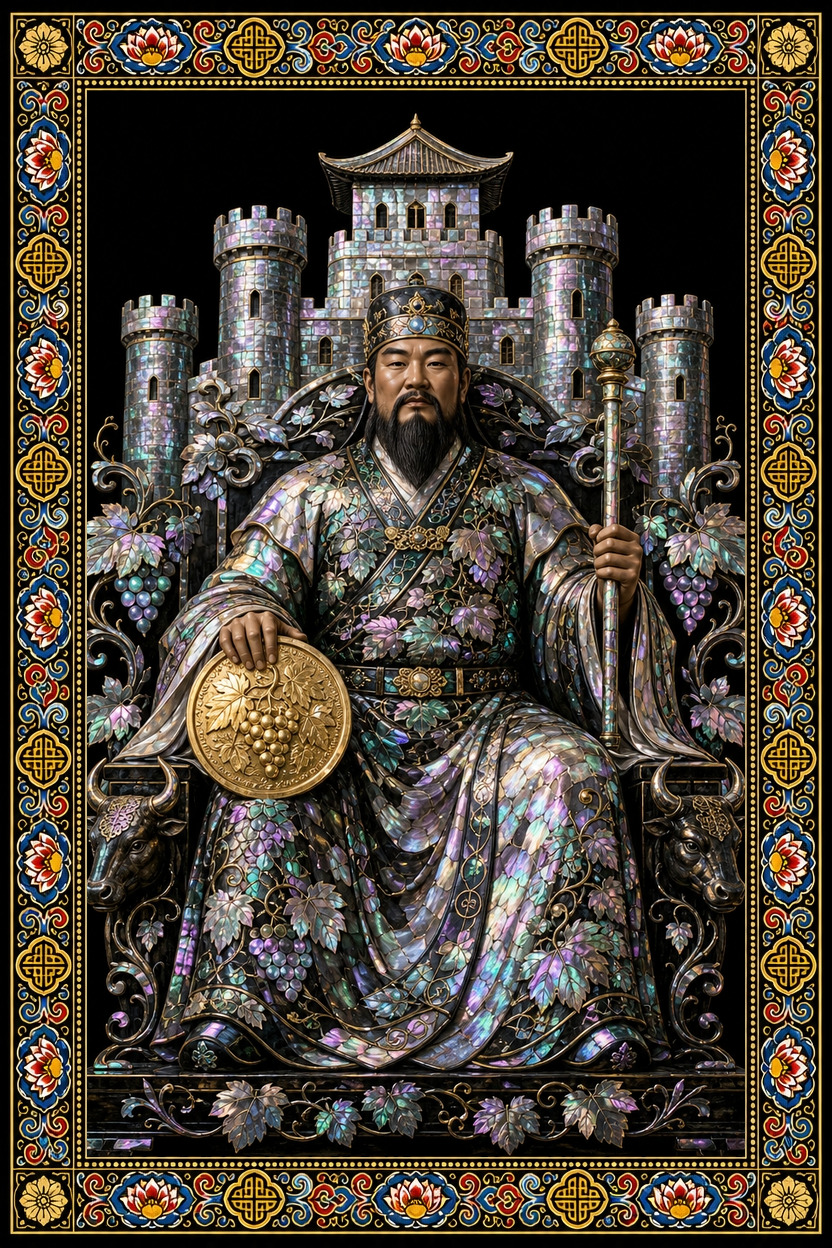
Pentacles · King of Pentacles
King of Pentacles — The King with the Grape-Stamped Coin and the Wall
What is the coin in his hand protecting? In the king's posture, his back to the wall, we read the gap between abundance and rigidity.
『King of Pentacles』 — what this card actually draws
What fills the frame first is not the figure but the background. A wall runs across the back of the card, and the throne stands before it. The bearded king on the throne faces straight ahead, lifting a coin in one hand.
The raised coin is stamped with a grape cluster. The other hand grips a sceptre, and a bull is carved into the side of the throne. The king's gaze is not turned outward but toward the coin in his hand.
What the king holds here is not a symbol of power but a single coin that fits within his palm. Between the large structures of wall and throne, his gaze rests on the small coin, and that is the first impression the card makes.
Symbols and meaning
The gesture of lifting the coin to examine it is closer to checking than to possessing. It is the posture of someone measuring again, with his eyes, what he has already taken in hand. So this card points to maturity in the place where what has been earned is guarded and put to work.
The bull carved on the side of the throne is a marker that holds fast to the nature of earth. The bull has long been drawn as a slow animal that ploughs to the end of the field, and with the wall set beside it, the sense of a stable enclosure overlaps. The grape cluster, too, is a fruit in which many berries set into one bunch, adding the image of harvest and fruition.
Reversed, the same elements work from the opposite side. When the hand that cannot let go of the coin tightens, checking becomes surveillance, and the wall becomes a wall that pens people in. When the hand on the sceptre remains only a tool of control, comfort is read as having hardened.
When this card appears
At work it points to the place where expertise built up over a long time bears fruit. Still, look alongside it to see whether you are holding every decision alone. Telling apart the share you can delegate becomes the key to the next step.
In relationships it appears as the person who has built trust through responsibility rather than words. Conversely, if caring for the other person has come close to managing them, it is better to step back for a while. Around money it asks about the border between the wish to protect your assets and the moment that wish hardens.
When the King of Pentacles sits at a choice, the question is which side carries the weight: stability or expansion. Set the judgment that keeps what you have beside the judgment that loosens it and spends it. Sooner or later he asks you to name both, and it surfaces in a sentence like this: "Once you have decided what to keep, you must also decide what to set down."
History and culture: najeon chilgi — inlaying crushed shell into lacquer
The coin in the king's hand is painted with a smooth sheen, one that recalls thinly shaved nacre; the coin itself is a painting, not a piece cut from shell. The craft of najeon chilgi (lacquerware decorated with mother-of-pearl) begins from the same principle. Pieces of nacre are cut and set onto a bamboo frame or a lacquered surface, then covered with several layers of lacquer and ground down until the grain of the shell finally shows.
Tongyeong and Wonju are known as places that have carried this technique on. Inlaying crushed shell is not a matter of sparing the material but a work of enduring its thickness. Left thick, the light dies; ground too far, the pattern disappears, so the feel at the fingertips decides the result.
The same tension runs through the lineage of patterns on najeon boxes from Goryeo into Joseon. Add splendour and the form grows heavy; hold back and the grain comes alive. The king's hand examining the coin is much like this. Measuring how much thickness of what you hold to leave is itself the work of handling abundance.
Common misreadings
This card is often read as a guarantee of material success. But what the image shows is less the achievement itself than how it is held. The same coin means something different once the hand tightens around it.
Because of the title of king, it is also limited to a card of older men or figures of authority. In practice it is more natural to see it as a marker of the nature of a role rather than of sex or age. Anyone who has long managed their own share stands in this card's place.
Nor is there any need to conclude that reversed means bankruptcy or loss. Reversed is closer to a mirror reflecting a state in which control has gone too far. Using it as an occasion to ask yourself what you are holding on to is enough.
Draw a card yourself
The picture you have just read can be placed against your own question. The same card answers differently when the question changes.
- A deck drawn in-house — 78 cards in the colours of nacre and dancheong
- Readings that read the picture, not a keyword list
- Keep asking — draw one more card for your next question
- A record you can return to and compare
- Let a friend draw for you with a single link
- Seventeen languages, one deck, one reading
More from this suit

