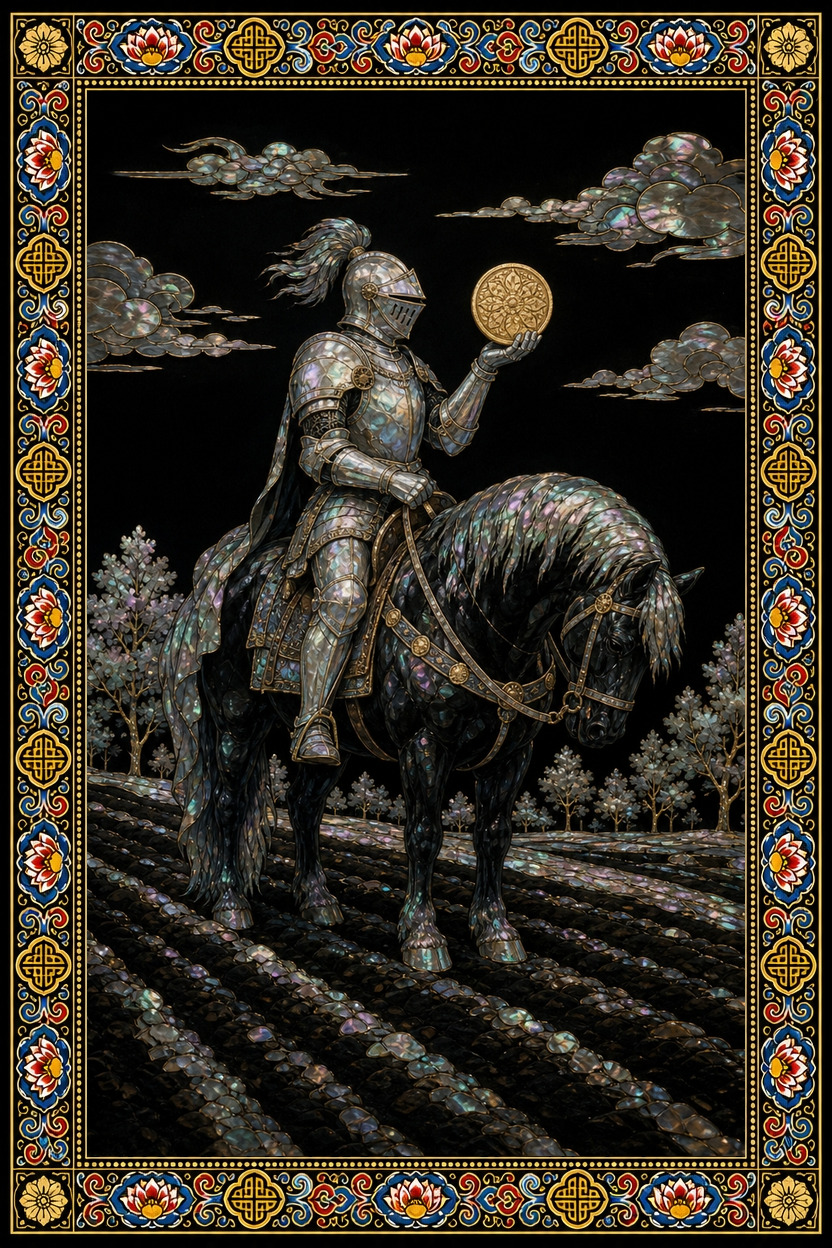
Pentacles · Knight of Pentacles
Knight of Pentacles — A Knight with a Gold Coin on the Furrows
What do the furrows running straight beneath the hooves say? Following the image of the Knight of Pentacles, this essay looks at how steady progress and standing still branch off from the same motion.
『Knight of Pentacles』 — what this card actually draws
At the centre of the image an armoured knight sits on a black horse. One gold coin is raised in his right hand, so the eye goes first, quite naturally, to that round piece of metal. The coin is held still at his fingertips, while beneath it the horse is in the middle of taking a step.
Beneath the hooves, furrows run side by side. The rows of freshly turned earth stretch out horizontally, showing that the road the knight has come by and the road ahead lie in the same direction. The sky, layered with low cloud, fills the upper part of the image without weighing it down, yet unmistakably.
The knight does not let the horse run. Nor does he thrust the coin high. The pose itself, armoured and given over to a slow walk, is the heart of the picture, and that boundary between stillness and advance makes up the card's character.
Symbols and meaning
The knight is the figure who carries movement within the suit, but the Knight of Pentacles does not move quickly. The black horse reads as an animal of strength and endurance rather than impulse, and the way it presses its hooves into the earth resembles the rhythm of a day's labour. The gesture of lifting the coin without throwing it is the attitude of one who confirms what has been gained and keeps it, not yet spending it.
The straight furrows meet the card's upright meaning. Like earth turned over again and again in the same direction, progress built from routine is unspectacular but certain. The armour tells us that this effort is not light, and it reads as a sign that diligence is itself a form of defence.
Reversed, the same picture looks different. The step halts, the hooves stay planted in the earth, and the familiar routine hardens into boredom and stubbornness. The hand that holds the coin and will not lower it can read either as fixation on the work or as a stagnation that fears change.
When this card appears
At work, this is a time when steady procedure counts for more than a great leap. Work stacked up in the same order each day turns into results, so keep the rhythm even when nothing visible changes. In relationships, the repetition of keeping promises is what builds trust.
With money, unhurried management is the key. Confirming and protecting what comes in, rather than spending it at once, creates stability. Faced with a choice, look for the road you can walk to the end rather than the fastest one.
When the knight's pace along the furrows feels frustrating, you come to see that the slowness was itself a safeguard. “Now is the time to check the direction of your steps rather than their speed.”
History and culture: the old grammar of number and figure
The Knight of Pentacles is the twelfth card within its suit. In ancient Greek number theory, twelve was held to be the number that carries the cycles of hours and seasons, and in medieval European iconography twelve often appears as the number that completes a circuit. The image of the knight walking the furrows reads like a scene passing through one point of that cycle.
The figures on this card are the circle and the horizontal line. The round coin at his fingertips means a completed one, and the parallel furrows underfoot mean a repeated line. Placing a single circle and several parallel lines in one frame is a structure that shows a single goal and the repeated steps toward it at the same time.
The story goes that where the number twelve and parallel lines meet, East Asian zodiac cycles and European divisions of the seasons were used in similar ways. What matters in this card, though, is not the grand symbolism of numbers but the sense that drawing the same line again is what makes time.
Common misreadings
Some conclude that the Knight of Pentacles means a great result is coming soon. But what this card draws is procedure, not outcome. What diligence guarantees is direction, not speed.
There is also the misreading that treats this card as merely frustrating because it is slow. The horse's walking pace is not a halt, and the furrows are earth already turned. Stagnation and progress sit on the front and back of the same picture.
Conversely, a reversed card need not mean you should give up the effort. Often an adjustment as small as adding one small change to a set routine is enough.
Draw a card yourself
The picture you have just read can be placed against your own question. The same card answers differently when the question changes.
- A deck drawn in-house — 78 cards in the colours of nacre and dancheong
- Readings that read the picture, not a keyword list
- Keep asking — draw one more card for your next question
- A record you can return to and compare
- Let a friend draw for you with a single link
- Seventeen languages, one deck, one reading
More from this suit
