Pentacles · Ten of Pentacles
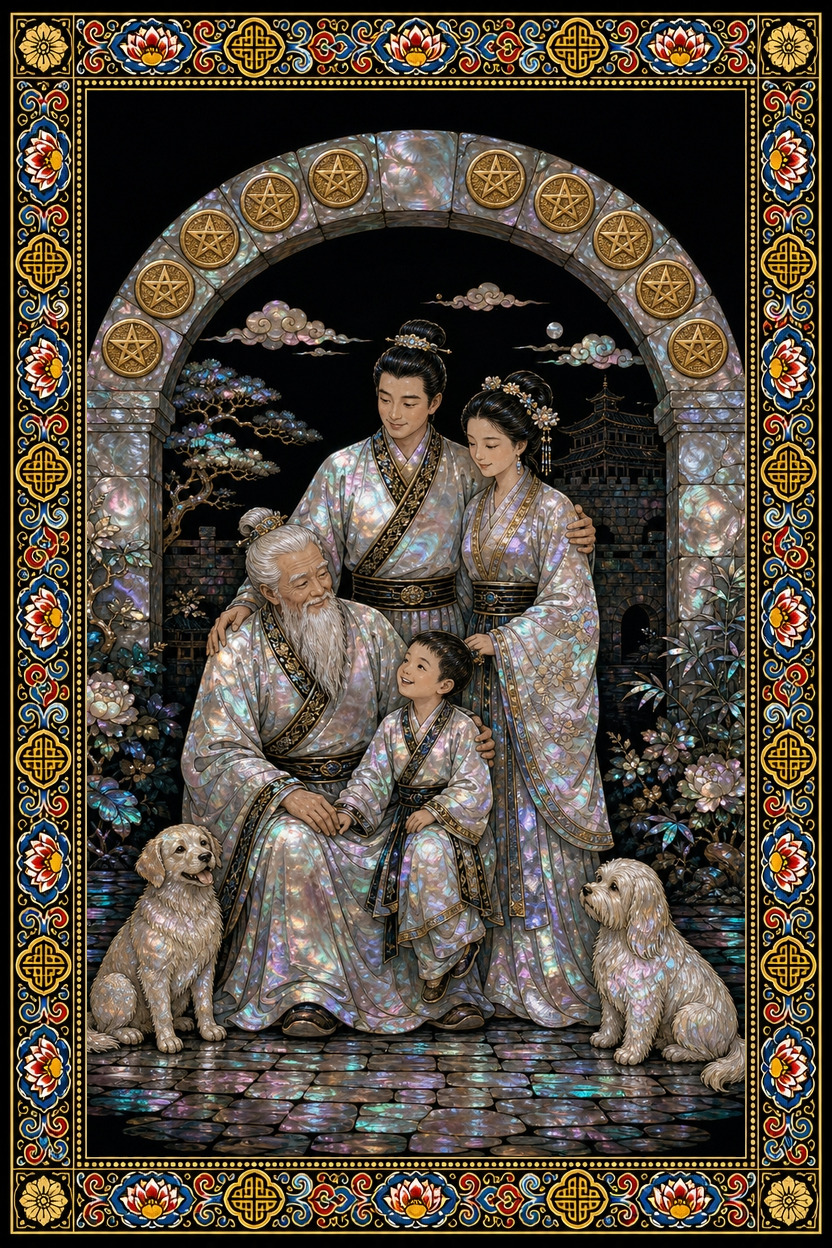
Ten of Pentacles — Three Generations Beneath a Stone Arch
What does it mean for a family to gather in one place? In the image of the Ten of Pentacles, we look at the foundations that last and the tensions that gather around them.
『Ten of Pentacles』 — what this card actually draws
Your eye lands first on the stone arch that spans the scene. Ten pentacles are carved into its pillars and its upper face, and the people stand in the space beneath it. The arch reads as a doorway and, at the same time, as a roof.
Beneath the arch, three generations in long robe (traditional dress) have gathered. In front stand an elder leaning on a staff and, beside him, figures who appear to be adult men and women; behind them stands a figure who looks like a child. At their feet, two white dogs sit side by side.
Behind the figures you can see a tiled-roof house and a sonamu (red pine). The house lies beyond the arch, and the people face it rather than turning their backs on it. The whole scene reads as a place on a threshold, neither indoors nor fully outdoors.
Symbols and meaning
The heart of this card is that the ten pentacles are carved into a structure rather than held by a person. That the wealth is set into walls and pillars rather than resting as coins in a hand shows that its value belongs to a structure, not to an individual. So the upright meaning leans toward accumulated foundations and an inheritance that carries forward rather than toward personal achievement.
Three generations in a single frame point the same way. An elder and a child beneath one arch mean that the span of time is folded into a single scene. The talk of family security and long-term foundations comes out of that overlap.
The reversed meaning draws the moment when this structure shakes. If the arch collapses, the pentacles lose the place they were carved into, and the people turn their backs on one another. Phrases like disputes over resources or unstable foundations point, then, not at the building but at the cracks between the people gathered beneath it.
When this card appears
At work, it reads as a time to build structures that will outlast the results in front of you. Think about what you inherit and what you will pass on, in an organization or in a profession. The question becomes what foundation will still be standing in a few years, rather than how you are rated today.
In relationships, the frame of family or of a long-standing community becomes the topic. Look at whether what you have built together is working as stability or has hardened into inertia. Around money, areas you cannot decide alone come up, such as inheritance or shared assets.
The choice laid out here is between short-term gain and a long-term foundation. Like the people standing beneath the arch, ask yourself whether this place belongs to you. This card often shows up through the sentence, "If I leave this place, what will I carry out with me?"
History and culture: French fortune-telling and the occult rearrangement
The detail that catches the eye here is that the pentacles hang on the arch rather than on a hand. Even in eighteenth-century France, when cards were rearranged into a fortune-telling tool, this iconography did not change much. In the Etteilla line of interpretation, too, the number ten was treated as the final place of completion and cycle.
In the nineteenth century, the work of Éliphas Lévi and the Golden Dawn circle layered Kabbalah and astrology onto this image. The iconography of the arch and the three generations itself, however, comes from earlier playing-card pictures, and the later correspondence tables are a layer added afterward. Reading the two layers separately makes it clearer where this card's centre of gravity lay.
In card use around the time of Mademoiselle Lenormand as well, ten was used as the place where one cycle closes. The detail that this card's ten are carved into a building shows an older view: that completion comes not from a person but from the structure left behind.
Common misreadings
This card is often read only as a guarantee of wealth and inheritance. But the centre of the picture is not the pentacles; it is the arch that holds them. What matters first is not the amount of wealth but the structure that supports it.
It is also common to interpret the card as saying a family must be harmonious. Three generations in one place does not mean there is no conflict; it means there is a shared frame in which conflict can arise. The reversed meaning deals precisely with cracks in that frame.
Finally, some read this card as a changeless stagnation. Everyone beneath the arch belongs to a different generation, and they are not staying in the same place but continuing across time. Stability is closer to continuation than to standing still.
Draw a card yourself
The picture you have just read can be placed against your own question. The same card answers differently when the question changes.
- A deck drawn in-house — 78 cards in the colours of nacre and dancheong
- Readings that read the picture, not a keyword list
- Keep asking — draw one more card for your next question
- A record you can return to and compare
- Let a friend draw for you with a single link
- Seventeen languages, one deck, one reading
More from this suit
