Major Arcana · The Devil
The Devil — The Chain Is Loose, the Torch Points Down
Why don't the two chained figures run away? Through the artwork of The Devil, this essay points out that attachment is a ring we fasten around our own necks.
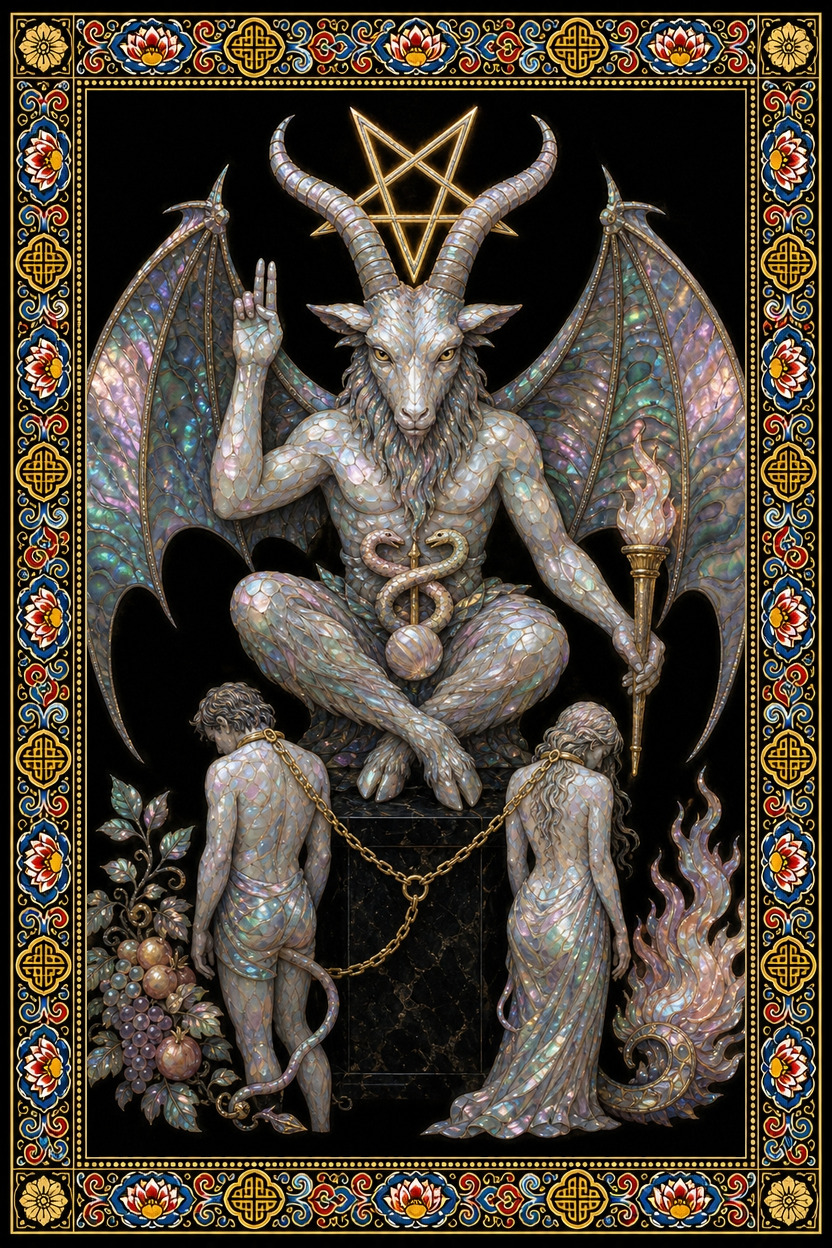
『The Devil』 — what this card actually draws
At the top of the image, a horned, goat-headed figure sits on a black pedestal with iridescent wings spread. Above its head hangs a five-pointed star with its point turned downward, and one hand holds a torch. The eye travels naturally from that torch downward.
Below the pedestal stand a small man and woman. Rings hang at their necks, and the chain that runs from those rings leads up to the pedestal where the figure sits. The chain is not pulled taut; it hangs loose.
Fruit lies beside the figure, and flames burn at the feet of the two people. The composition is arranged to be read from top to bottom, from the torch to the chain, and from the chain to the flames at their feet.
What deserves attention in this scene is the state of the chain. They are bound, yet the rings at their necks are slack, and their hands are free. The image draws confinement while leaving room for that confinement to come undone.
Symbols and meaning
Upright, this card points to the harness that attachment and temptation create. That the two figures stand in place even though the chain is loose shows they are not held by force but are staying of their own accord. When material things, habits, or a particular relationship take up the centre of life, we are in effect hanging that ring around our own necks.
The inverted pentagram above the head symbolises an order turned upside down. In this card, which belongs to the element of Earth, material things are the ground that supports life, but once they become the goal, the order of judgement goes askew. The torch pointing downward is read in the same context.
Reversed, the meaning shifts toward the chain coming loose. What matters is the fact that the chain in the image was loose to begin with. Breaking free is less an event in which someone else undoes your bonds and more a process of noticing that you are bound and taking the ring off yourself. Awareness comes first, and letting go follows.
When this card appears
At work, it asks you to check whether you are driving yourself under the name of efficiency. If something you began because you loved it has become an attachment hard to release, it is time to look at where that drive came from. In relationships, try to separate the feeling you have toward the other person from the urge to hold on to them.
With money, it points to the paradox that the more ownership grows, the narrower your range of choice becomes. If you have let material goals define you, it is worth returning to the reason you wanted them in the first place. Faced with a choice, ask whether the immediate temptation points in the same direction as a satisfaction that lasts.
Reversed, the Devil finds you already aware of the ring on your ankle. Loosening it happens slowly, so choose one small distance you can put in place today. What the cards tend to surface here is a plainer truth: "What feels like being bound right now may in fact be something you are refusing to let go of."
History and culture: the Visconti-Sforza deck and the Milanese court
In the gold-leaf deck commissioned by the Sforza court around 1450, the image corresponding to this card already had the composition of a horned figure with two bound people beneath it. These costly handcrafted cards, finished with gold leaf, were never widely distributed goods to begin with; they were made as possessions of the court.
What stands out is the clothing of the two chained figures. They are drawn not as people of the street but in the dress of the nobility of the day. For those who owned the cards, this image was a mirror reflecting something that could happen in their own station, not someone else's story.
The way court ritual and heraldry permeate the imagery also shows the character of this deck. Expensive cards were tools for contemplation and conversation, and the story goes that the figures within them were read as symbols aimed at the owner's life and faith.
Common misreadings
People often take this card as a signal that something bad is coming. But the chain in the image is loose, and the two figures' hands are not tied. This card is closer to an invitation to look at what is holding you right now than to a warning of disaster.
Another misreading is that this card names a specific object or person. The figure in the image is not a portrait pointing to someone but a personification of the universal forces of temptation and attachment. Which relationship or habit is the problem is for you, the reader, to fill in.
Some also read the reversed card only as "bad things not yet finished." In fact, the reversed position is used to point to a phase of awareness and recovery. Even if the process of breaking free is slow, you can take it that the direction has already changed.
Draw a card yourself
The picture you have just read can be placed against your own question. The same card answers differently when the question changes.
- A deck drawn in-house — 78 cards in the colours of nacre and dancheong
- Readings that read the picture, not a keyword list
- Keep asking — draw one more card for your next question
- A record you can return to and compare
- Let a friend draw for you with a single link
- Seventeen languages, one deck, one reading
More from this suit
